They slashed the painting. The museum hung it back up.
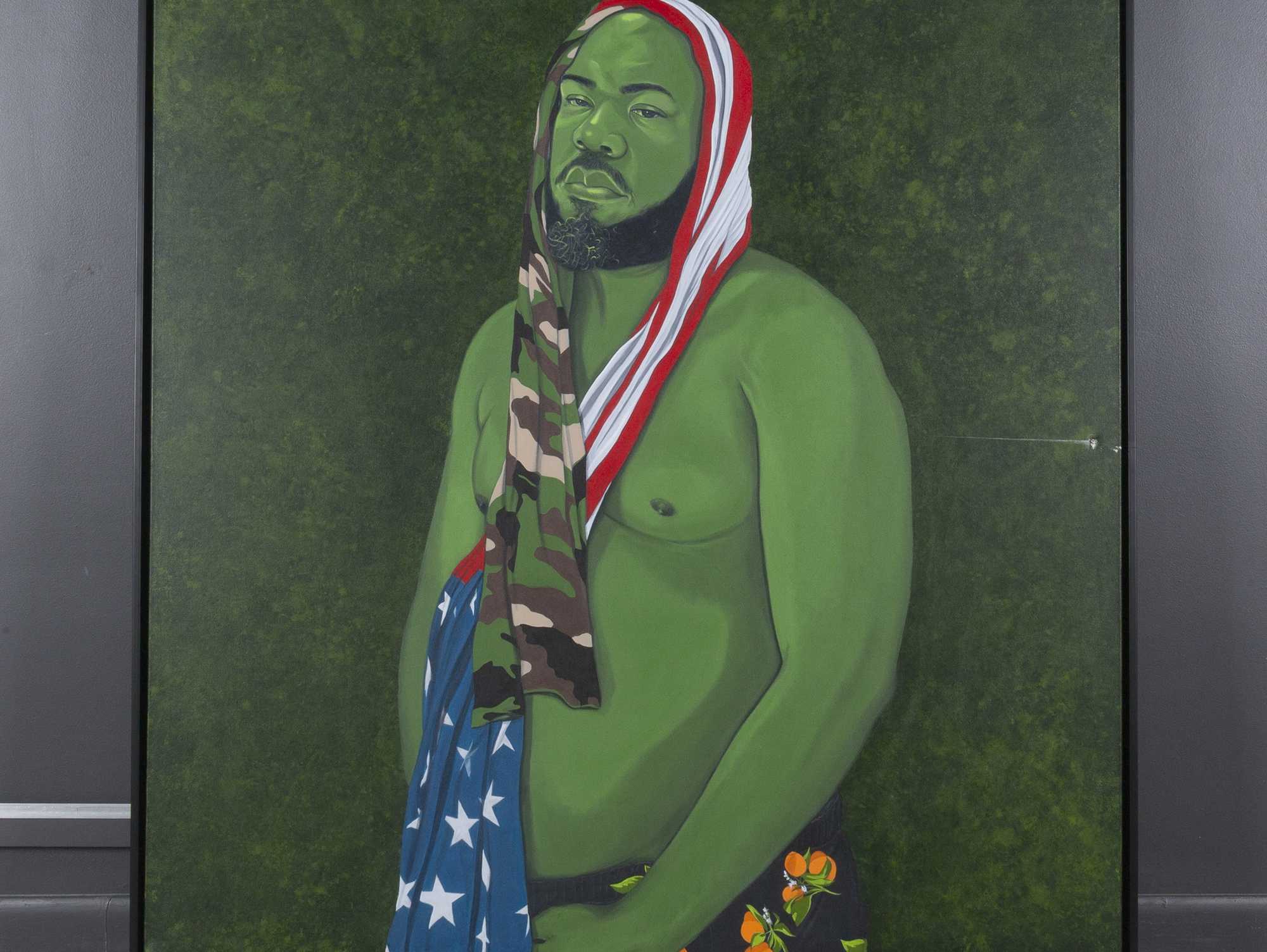
On May 21, a visitor walked into the Houston Museum of African American Culture and intentionally damaged Clarence Heyward’s painting Man in the Garden: a puncture, and a long cut. The museum filed the police report, called the conservators, and then did the thing I have not stopped thinking about. They put the damaged painting back on the wall. This is the story, what the work means, and why I am not letting it get buried.
A note on sourcing, because accuracy is the brand: the facts below come from HMAAC’s public statement and the reporting that followed the museum’s June 9 press conference, the one I told y’all on the live I was trying to get to. Where something is the museum’s account, I say so. Where something is my read, I say that too.
What happened.
On May 21, two visitors walked into HMAAC on Caroline Street. By the museum’s account, two young white men, one carrying a large bag. Upstairs, they made obscene gestures at the work on view. Then they went downstairs, into EDEN, the exhibition of work by North Carolina artist Clarence Heyward, curated by John Guess Jr. They left a puncture and a long cut in Heyward’s painting Man in the Garden, and walked out.
The museum’s security cameras had malfunctioned the day before. The work order to repair them went in hours before the two men arrived. Sit with that timing however you need to. HMAAC filed a report with the Houston Police Department; as of the press conference, the museum said it had heard of no movement in the case. The museum also said this out loud: this is the first work ever defaced at HMAAC, but its logbook holds threats that came before it. The defacement is new. The hostility is not.
The work they chose.
I want you to understand what was cut, because vandalism like this is never just about canvas. Heyward, Brooklyn-born, based in North Carolina, represented by Richard Beavers Gallery, paints Black people, often his own family, with green skin. The green is not decoration. In his own framing, it points at the green screen: the film technique where a green surface gets replaced by whatever reality the producers decide to project. That is the argument of the work, what it is to exist while Black in America, with the world forever projecting its chosen image onto your skin.
So when someone punctures and cuts Man in the Garden inside Houston’s museum of African American culture, the target is not paint. The target is the idea. Everyone involved understands this, which is why the museum’s response matters so much.
The target was never the canvas. Canvas can be restored. The target was the idea, and the idea is doing fine.
What the museum did.
HMAAC took the painting down to begin restoration. Then it made a decision I have not stopped thinking about since: it put the damaged painting back on the wall, wound visible, so the public could see exactly what was done. No hiding the harm. No quietly fixing it and pretending Houston is something it is not that day. The cut itself became the exhibition.
At the June 9 press conference, CEO Emeritus John Guess Jr., who curated EDEN, said the quiet part at full volume: “If we’re honest about it, this is a very racist town.” And in the museum’s statement he drew the line that I think every cultural worker should pin above their desk: “Museums exist to encourage inquiry, reflection, and conversation… We reject violence as a response to ideas and remain committed to creating space for thoughtful discussion, even when conversations are difficult.”
CEO Davinia Reed kept the museum’s eyes where they belong: “Our immediate priority is supporting the artist and ensuring the proper restoration of the work,” and then, plainly: “Acts intended to intimidate, censor, or damage cultural expression will not deter us from our mission.”
We celebrated this work. Eighty thousand of us.
Some of y’all met Clarence Heyward’s work through this platform. We celebrated it in Chicago, in person, in front of the paintings. And since then, the numbers tell a story I want him to hear right now: 80,000 of you have seen his work through this platform. More than 8,000 of you loved it. You shared it nearly two thousand times. That love started right here, and it was real, and it moved.
So this is me asking for the same energy now, pointed at this moment instead of the feed. The hate got one visitor with a blade. The love has eighty thousand of us. We need to love on him in moments like this, out loud, where he can see it: in his comments, in his DMs, in the collecting decisions of anyone positioned to make one. This is not ok, and saying so is the floor, not the ceiling.
I grew up near Vidor. None of this is new to me.
I want to tell you why this story sits in my body the way it does. I grew up in Texas, close to the Louisiana border, down the road from Vidor. If you know, you know. Vidor was one of Texas’s most notorious sundown towns. In 1993, when the federal government tried to desegregate its public housing, the Klan rallied in the streets, and Bill Simpson, one of the first Black residents to move in, was hounded out of town and shot dead in Beaumont within hours of leaving. Five years later, one county over in Jasper, three white men chained James Byrd Jr. to the back of a pickup truck and dragged him three miles.
I am not reaching for history. I am telling you about the soil I grew up on. So when two men walk into the only museum of African American culture in Houston, make their gestures upstairs, and put a blade through a Black man’s portrait downstairs, these acts are not new to me. The blade is old. The question is never whether this hate exists in Texas. The question is what we build in front of it, and what we do when it shows up at the door.
Here is my answer, and it is the whole thesis of this platform applied to one painting: when we bring art into our city carrying messages this beautiful and this strong, we have to protect the messages. Protection looks like attendance. It looks like funding. It looks like eighty thousand people refusing to scroll past. It looks like a museum hanging the wound on the wall and a city showing up to face it.
Why I am not letting this get buried.
I said it on the live and I will put it in writing: stories like this get buried. Not by conspiracy, just by the news cycle, because a damaged painting at a culturally specific museum does not trend the way an auction record does. But look at what is actually in this story. The only museum of its kind in Houston, operating without dedicated public funding, showing a Black painter’s meditation on projection and skin, and somebody walked in and put a blade through it. If the field talks for a week about a Pace press release and goes quiet on this, that silence says exactly where the field’s attention lives. Not here.
And there is a Houston layer to this that I refuse to skip. I have spent this whole year telling y’all that Houston is the most under-estimated art city in the country, that the next capital will not look like the last one. This is part of that same story, the harder part. A city’s art ecosystem is not just its fairs and its collectors. It is whether its institutions can show difficult work without that work getting cut, and what the city does when it happens. HMAAC just showed Houston how an institution stands up. The question is whether Houston stands up with it.
What you can actually do.
Visit the museum. The EDEN exhibition has since come down, so the painting itself is no longer on view. The institution is. HMAAC, 4807 Caroline Street, in the Museum District. Walk through whatever is on the walls right now, sign the book, and take somebody with you. Attendance is a statement they can count.
Support the institution. HMAAC runs without dedicated public funding. Membership, donation, attendance: all of it is infrastructure. If you are a collector who has been waiting for a moment where your patronage means something beyond acquisition, this is what one looks like.
Say the artist’s name. Clarence Heyward. Man in the Garden. The EDEN exhibition. Follow the work, share the work, and if you are in a position to collect it, know that his gallerist is Richard Beavers. The loudest possible answer to someone cutting a painting is a career that keeps rising anyway.
The closer.
On the live, before I had all the facts, I said the thing I always say, and now that I have the facts I will say it again with my whole chest. You cannot have a glory without the story. This is now part of Clarence Heyward’s story, part of HMAAC’s story, part of Houston’s story. The cut is in the canvas. What it becomes is up to the rest of us. Let it fuel something. Go stand in front of the painting and decide what.
I’ll keep following this one: the investigation, the restoration, and what the museum needs. When there is news, you will hear it here and on the Tuesday Live. Stay close to your story. I’ll see y’all Tuesday.
Sourcing: HMAAC public statement and June 9 press conference, via CultureMap Houston and Black Art in America.
Moriah Alise